Free tool spots AI watermarks in images, video, audio
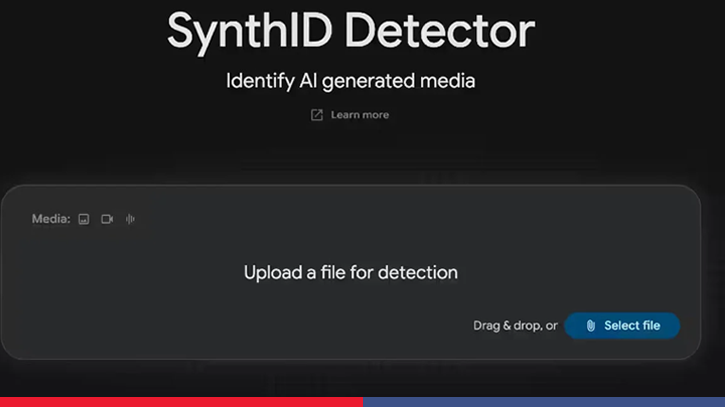
Photo: Collected
Google has made its SynthID Detector web tool freely available to the public, enabling anyone to check whether images, videos and audio carry the company’s SynthID watermark, as efforts to identify AI-generated and manipulated content gather momentum.
According to the technology news outlet Engadget, the tool can detect watermarks in content created with AI tools from Google, OpenAI, Nvidia and Kakao, although users must sign in with a Google, OpenAI or Apple account to access it. Google has also indicated that it intends to add support for identifying images generated or edited with Apple Intelligence. Following more than a year of development, the tool has evolved beyond earlier versions aimed primarily at journalists and media professionals, and anyone can now check eligible content at SynthID.com. Furthermore, Google’s Circle to Search feature and the Gemini app can already recognise SynthID watermarks and C2PA Content Credentials; nevertheless, the dedicated website is intended to make verification more accessible, particularly for those who do not use Google’s AI products.
However, SynthID Detector has considerable limitations. Because different companies employ different watermarking technologies and standards, it cannot identify every type of AI-generated content. Moreover, material lacking a detectable watermark may escape detection, while watermarks themselves could, in some circumstances, be removed. The tool is also unable to distinguish between media produced entirely by AI and conventional content that has merely been modified with it, nor can it explain precisely how a piece of content was made or which elements were AI-generated.
Read More: Hackers claim theft of 19 million Pathao accounts
Meanwhile, rival technology firms are developing comparable capabilities. Meta, for instance, is testing a web tool designed to identify images generated or edited with its Muse image model, though its capacity to detect content created by competing AI systems remains limited. Google, for its part, plans to broaden SynthID Detector’s coverage through partnerships with other companies and has previously announced plans to support watermark detection for audio generated by ElevenLabs. Ultimately, although the tool represents a further step towards exposing synthetic media, its results should not be regarded as conclusive proof of authenticity, and users are well advised to weigh additional reliable evidence and verification methods before judging whether digital content is genuine.
newsbangladesh.com/mb