Ramisa murder case: sohel and swapna sentenced to death
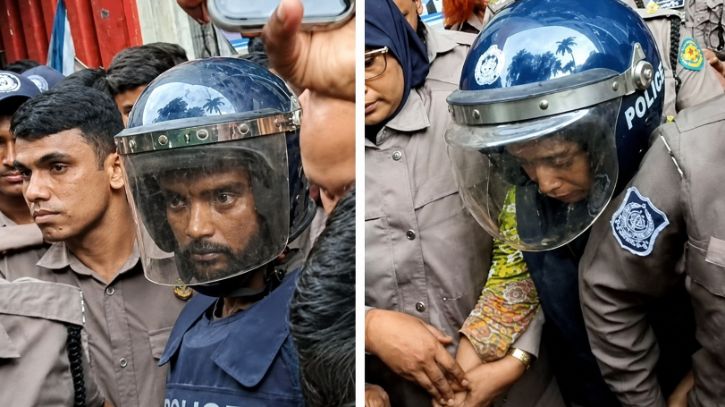
Photo: Collected
A court has sentenced the prime accused, Sohel Rana (30), and his wife, Swapna Akter alias Swapna Khatun (26), to death in the sensational case involving the brutal rape and decapitation of an eight-year-old child, Ramisa Akter, in Pallabi, Mirpur, Dhaka. The court also fined each of them 500,000 BDT.
Judge Masrur Salekin of the Dhaka Child Violence Prevention Tribunal announced this historic verdict on Sunday (June 7) at 11:37 AM in a crowded courtroom in the presence of the accused.
This marks the first time in the country’s judicial history that a rape and murder case trial has been completed and a verdict delivered within just four working days. In anticipation of the verdict, unprecedented and strict security measures were put in place around the court premises since morning, involving extra police forces and plainclothes intelligence operatives.
Case Details
According to court and case sources, the victim, Ramisa Akter, was a second-grade student at Popular Model High School in Pallabi. On May 19, around 9:30 AM, when Ramisa stepped out of her home, her neighbor Sohel Rana’s wife, Swapna Akter, deceptively lured her into their flat. Around 10:30 AM, Ramisa’s mother began searching for her to send her to school. At one point, she noticed Ramisa’s shoes outside the door of the third-floor flat. Receiving no response from inside despite repeated calling, Ramisa’s parents and other residents of the building broke open the door. Inside, they discovered Ramisa’s headless, bloody body on the bedroom floor and her severed head inside a large bucket nearby.
Immediately after the incident, locals notified the police via the national emergency service 999. Pallabi police quickly arrived at the scene and took Swapna Khatun, who was trapped inside the room, into custody. However, the main accused, Sohel Rana, had already escaped by cutting through the window grills. Utilizing information technology, police managed to arrest Sohel Rana just 7 hours later in front of the Fatullah Police Station in Narayanganj district. The day after the brutal incident, May 20, Ramisa’s father, Abdul Hannan Mollah, filed a murder case at Pallabi Police Station against Sohel Rana and Swapna Akter.
Confession and Trial
Following his arrest, on May 20, the prime accused Sohel Rana gave a chilling and detailed confession under Section 164 of the Code of Criminal Procedure before the court of Dhaka Metropolitan Magistrate Aminul Islam Juneayd.
Read More: Deputy speaker calls for national child safety taskforce
In his confession, Sohel stated that he regularly consumed drugs. On the morning of the incident, when the neighbors from the adjacent flat left, he found 8-year-old Ramisa alone and dragged her into his bathroom to rape her. When the child tried to scream, he tied her mouth with a scarf and raped her. At one point, the child lost consciousness. Believing she was dead, he fetched a knife from the room and decapitated her to destroy evidence and hide the body. As he was attempting to sever her hands, he heard Ramisa's mother calling out from outside. Panicked, he cut the window grill with a slide wrench and fled.
During the framing of charges, Sohel claimed that another individual named "Dollar" was involved, but investigations by the prosecution and the investigating officer found no evidence of anyone else's presence.
During the self-defense hearing on June 3, Sohel addressed the court saying, "Sir, I made a mistake, and Dollar made a mistake too. Please catch him, sir. I have a child, please forgive me." He also attempted to claim his wife was innocent. On the other hand, his wife Swapna Akter claimed innocence in court but could provide no logical explanation for why she did not open the door.
Unprecedented Speed in Justice
Sub-Inspector (SI) Ohiduzzaman Bhuiyan of Pallabi Police Station investigated the case with high priority and submitted the charge sheet just 5 days later, on May 24. On the same day, the case was transferred to the Child Violence Prevention Tribunal for resolution. Due to the Eid-ul-Adha vacation, charges were formally framed on June 1 to begin the trial. Although general court vacations were active, the tribunal's vacation was canceled via a special order to ensure the swift disposal of this sensational case.
Following the framing of charges on June 1, the recording of depositions began with unprecedented speed on June 2. On that day, the court recorded the testimonies of 16 out of 17 registered witnesses. The witnesses included Ramisa's father, mother, elder sister, aunt, uncle, neighbors, police constables, the medical examiner, and the investigating officer. Following self-defense arguments on June 3 and closing arguments from both sides on June 4, the court fixed June 7 for the verdict.
The Judgment
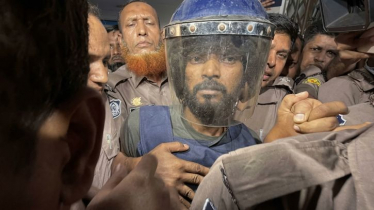
Around 8:30 AM today, Swapna Akter was brought from Kashimpur Central Jail under tight security, and prime accused Sohel Rana was brought to the Dhaka Metropolitan Sessions Judge Court lockup in a prison van at 8:50 AM. At 10:45 AM, Sohel was brought to the courtroom wearing a helmet and a bulletproof jacket under maximum security. At 11:00 AM, Judge Masrur Salekin began reading the main operational part and observations of the verdict.
In his observations, the judge noted that medical certificates, video footage, recovered blood-stained evidence, and the accused's confession under Section 164 beyond any doubt proved that Sohel Rana had raped child Ramisa before murdering her. This confession was never retracted by the accused. Special prosecutor Azizur Rahman Dulu successfully argued that while Sohel Rana was committing this horrific crime and subsequently escaping from the blockaded room, his wife Swapna Akter knowingly directly assisted him in fleeing and concealing information.
Although the state-appointed defense lawyer, Musa Kalimullah, argued that Sohel Rana was heavily intoxicated during the incident and should receive life imprisonment instead of the death penalty, and that Swapna Akter should receive a lighter sentence under Section 201 for merely assisting in hiding the body, the court rejected those arguments.
The court clarified in its verdict that both husband and wife are equal partners in this crime. Considering the severity and cruelty of their offense, the highest punishment is the only exemplary way to eradicate such crimes from society. Consequently, the court concluded the historic case by sentencing both prime accused Sohel Rana and his wife Swapna Khatun to death
newsbagladesh.com/nd