Educating a girl means shaping the future of a generation.
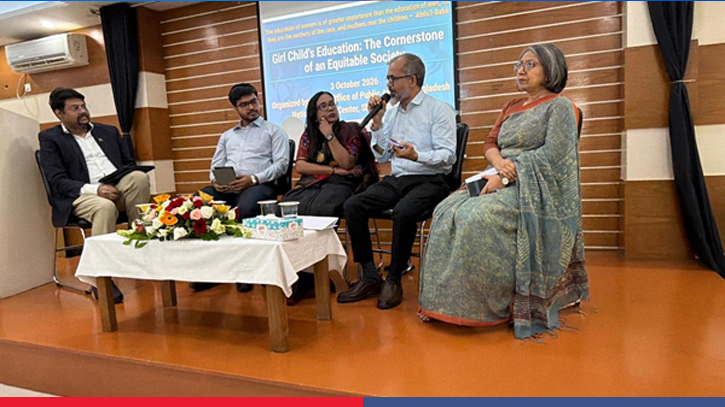
Photo: Collected
Educating a girl is not just about imparting education to an individual; it means placing the light of the future in her hands.
This message emerged from a discussion titled "Girl Child's Education: The Cornerstone of an Equitable Society," held at the National Bahá'í Center in Dhaka.
According to the participants, educating a girl is not merely about shaping a future, but about building the future of a family, a generation, and ultimately an entire society.
Panelists emphasized that true education is not limited to good academic results or degrees. It must foster intellectual, moral, and spiritual qualities—such as honesty, a sense of justice, empathy, and mutual respect.
During the event, speakers called for joint initiatives among families, communities, and institutions to ensure a safe learning environment for all children and to eliminate barriers like poverty, child marriage, superstition, and the digital divide.
Mahrukh Mohiuddin, Managing Director of University Press Limited and an intellectual, highlighted that girls' education is vital for creating an equitable society. She noted that it is both a fundamental right and a driving force for social change. Educated girls can make informed decisions, earn a livelihood, and challenge inequality. Citing examples from Bangladesh and Rwanda, she demonstrated that prioritizing gender equality nationally through sustainable investment can bridge the gender gap.
Omar Farooq from Save the Children stated that while Bangladesh has made remarkable progress in girls' education, participation alone does not guarantee equality. It is essential to create an environment where girls can learn safely, complete their education, and choose their own futures.
Nasima Ahmed of the Bangladesh Bahá'í Community reiterated that girl child education shapes families, generations, and society at large. She explained that from a Bahá'í perspective, girls' education is given special priority because women are the first and most important teachers of the next generation.
Zeeshan Uddin, an engineer and member of the Bahá'í community, described education as the foundation for an equitable and self-reliant society. He stressed men's responsibility in supporting girls' education and advancement, valuing girls' opinions within families, and trusting their capabilities.
The event concluded with a lively and interactive open discussion where participants exchanged views and highlighted the importance of moral education for both boys and girls. Speakers also noted the Bahá'í community's active role in conducting special educational programs across all levels of society and invited everyone to participate in these courses to contribute to children's moral education.
The session was moderated by Dr. Kalis Ali of the Bangladesh Bahá'í Community.
newsbagladesh.com/nd