One Planet, No Climate Borders

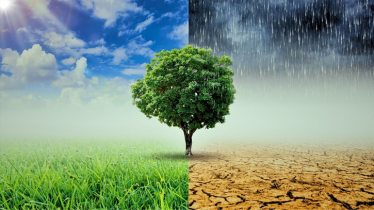
photo: AI Generated
We share one planet, and on that planet, climate has no borders. Nepal's recent, devastating flash floods drive the point home. They stand as a stark reminder of a truth the world can no longer afford to ignore: climate disasters do not stop at national borders, distinguish between rich and poor countries, or spare nations simply because their contribution to global greenhouse-gas emissions is small.
Nepal is a striking example of this injustice. According to global emissions reports, Nepal contributes less than 0.1 percent of global carbon dioxide emissions, yet it remains highly vulnerable to climate-related disasters. Videos of the recent flash floods show how quickly extreme weather can become a humanitarian tragedy, destroying homes, infrastructure, and livelihoods, and putting countless lives at risk. On a planet with no climate borders, distance from a smokestack offers no protection.
The tragedy deepens with Nepal's geography. Home to some of the world's highest peaks, Nepal sits within the Himalayan region, sometimes called the "Third Pole" for its vast ice reserves. Nepal's glaciers have lost roughly one-third of their volume over three decades as temperatures have risen, threatening water security and agriculture for the millions who depend on Himalayan rivers.
As glaciers melt faster, the consequences unfold in stages: swelling rivers, unstable glacial lakes, and sudden downstream floods, followed by long-term threats to water supplies for farms and communities. What happens high in the mountains eventually reaches people far below, another reminder that on one planet, climate impacts travel freely across every line drawn on a map.
The recent flash flooding has made the human cost impossible to ignore. Numerous videos circulating online show rescuers wading through treacherous floodwaters to save people from the affected areas. According to the Nepal Flash Floods Aftermath Live Report of The Hindu as on September 3, 2026 at 6.24 am IST; the death toll has risen to 1,250. Search-and-rescue operations are still underway, while nearly 4,000 people are still missing. Among the missing people, 583 are foreigners. As of today, 11,993 people have been rescued by the security forces.
Read More: The unseen costs of Climate Disasters
Behind these numbers lie countless personal tragedies - families separated, homes swept away, and communities struggling to recover. For many survivors, the disaster has taken not just their homes but their livelihoods, stability, and sense of security.
This is the fundamental injustice of climate change: those who contribute the least can suffer some of the greatest consequences.
For decades, industrialized economies have produced a disproportionate share of historical greenhouse-gas emissions. According to the UNEP Emissions Gap Report 2025, the G20 accounted for about 77 percent of global emissions in 2024. Meanwhile, countries such as Nepal and Bangladesh, which have contributed comparatively little to cumulative emissions, face extraordinary exposure to climate hazards. This imbalance raises a central question of climate justice: who should bear the cost of a crisis created collectively but caused unequally?
Climate change is not simply an environmental issue - it is a matter of justice, development, poverty, and human rights. A single flood in Nepal can erase decades of progress, sweeping away roads, bridges, schools, and farms in hours, while disrupting transportation, electricity, and food supplies and forcing governments to divert scarce resources toward emergency response.
This is why climate has no borders. The atmosphere does not recognize political lines; carbon dioxide emitted in one country mixes globally and warms every corner of the planet. A nation cannot isolate itself from global warming simply by cutting its own emissions. But this interconnectedness must not become an excuse for inaction. Every country has a responsibility to cut emissions and build resilience according to its capacity, while nations with greater historical emissions bear a particular responsibility to support vulnerable ones, especially across South Asia.
For Nepal, adaptation is essential: stronger early-warning systems, climate-resilient infrastructure, safer settlements, and continued monitoring of glaciers and glacial lakes. But adaptation alone cannot solve the problem if global temperatures keep rising. The world must also address the root cause - greenhouse-gas emissions.
Bangladesh, India, Bhutan, and Pakistan face interconnected climate risks, from floods and cyclones to droughts and shifting rainfall patterns - proof that on one shared planet, no country's climate risk is separate from its neighbors'. This borderless risk demands borderless solutions: stronger regional cooperation on disaster preparedness, weather forecasting, and river management, alongside financing that reaches front-line communities rather than getting trapped in bureaucracy.
Most importantly, climate action must move beyond speeches and declarations. The people facing floods, storms, droughts, and disappearing glaciers cannot afford endless promises. They need practical action: safer infrastructure, reliable warnings, resilient livelihoods, accessible finance, and international solidarity to reduce global warming.
The images of rescuers carrying people from floodwaters are more than scenes of a natural disaster. They are a warning to the world, showing how climate change ultimately becomes a human crisis - and behind every statistic is a person whose life has been disrupted. A country's emissions may be small, but its vulnerability may be enormous. Countries with greater historical emissions bear a greater responsibility to lead the transition toward a low-carbon future and help those already suffering the consequences.
Climate change is global, but climate vulnerability is unequal. Political borders may separate countries on a map, but they cannot separate them from the atmosphere, rivers, and weather systems that connect our planet. We live on one planet, and climate recognizes no borders on it - so our responsibility to prevent disasters, prepare for them, and protect those most vulnerable cannot recognize borders either.
Climate justice is not charity; it is a shared responsibility. If emissions produced in one part of the world can contribute to suffering in another, then climate action, financing, technology, and solidarity must cross borders as well. Nepal's floods should not be viewed as an isolated national tragedy. They should be understood as proof that we live on one planet, where climate has no borders: no nation can escape a changing climate alone, and no country should be left to face its consequences alone.
Nicholas Biswas is a freelancer.
newsbagladesh.com/nd