Jute sticks turn byproduct into profitable sideline
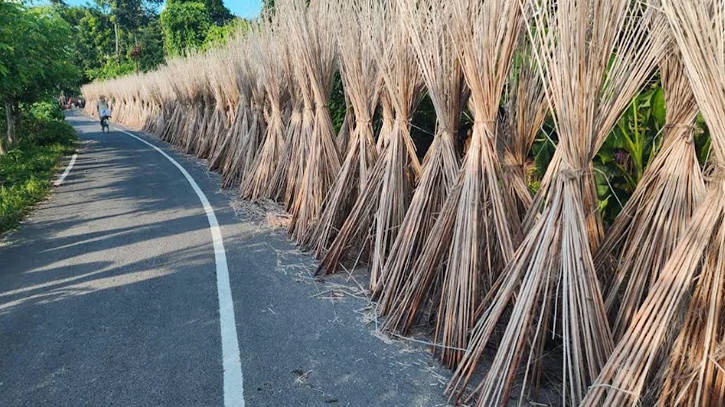
Photo: Collected
Jute sticks, once dismissed as a mere by-product of jute cultivation, are emerging as a valuable supplementary income stream for farmers in Meherpur, with rising demand and improving prices encouraging growers to expand cultivation despite persistent concerns over the profitability of jute fibre itself.
Although farmers' expectations regarding fibre prices are not invariably met, the proceeds from selling jute sticks allow them to recoup a substantial share of their production costs, with certain growers even reporting higher earnings from the sticks than from the fibre proper. In Meherpur, cultivating jute on one bigha of land costs approximately Tk 20,000–25,000 and yields around 10 maunds of fibre, which currently fetches roughly Tk 3,000 per maund, generating some Tk 30,000 in total; the sticks harvested from the same plot, meanwhile, can command a further Tk 10,000–15,000 depending on quality, furnishing farmers with a crucial secondary revenue stream that considerably offsets their overall outlay.
Traditionally confined to household fuel use, the sticks are increasingly being repurposed for fencing around homesteads, cattle sheds and cropland, while demand has steadily spread beyond rural communities to urban consumers as well. Traders typically purchase sticks from farmers at Tk 10,000–15,000 per bigha before reselling them in bundles, a practice that can yield Tk 25,000–30,000 at retail. Experts contend that proper processing could unlock considerably greater economic potential, noting that jute sticks lend themselves as raw material for particleboard, fibreboard, paper, handicrafts and a range of other environmentally sustainable products.
Read More: Natore farmers busy with Aman rice planting
According to the Department of Agricultural Extension, some 16,630 hectares were brought under jute cultivation in Meherpur this season, a figure officials attribute in part to the growing appeal of jute sticks as a dependable secondary income source. Taken together, these trends suggest that what was once regarded as agricultural waste is steadily being reconceived as an integral component of the crop's overall value, one capable of sustaining farmer interest in jute cultivation even when fibre prices themselves fail to satisfy expectations.
newsbangladesh.com/mb